


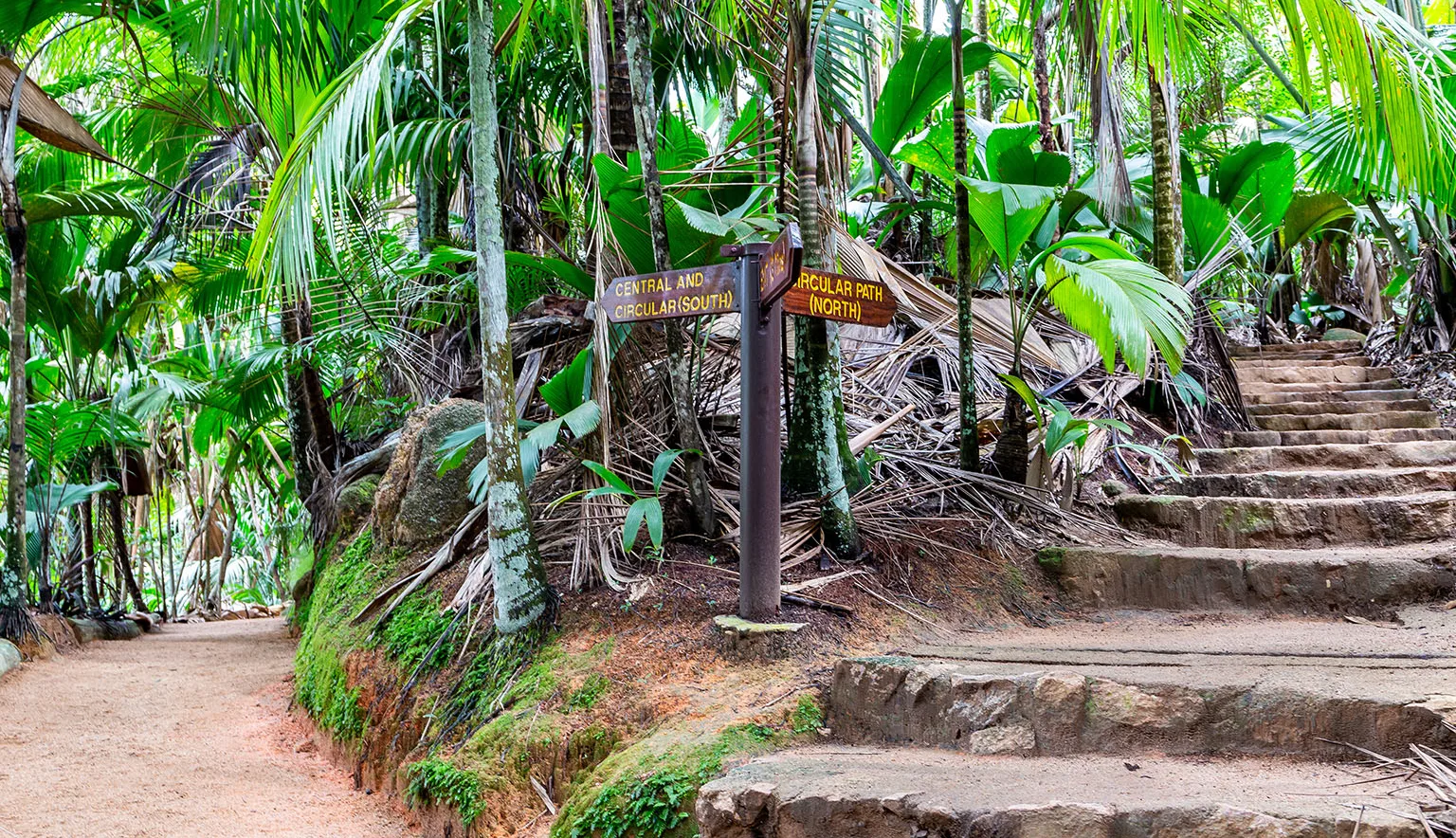

The ‘Garden of Eden’ is a nickname that only begins to cover the allure and tempting call of the Vallée de Mai – an ancient palm forest on the island of Praslin.
Having been under protection since 1966 and declared a UNESCO World Heritage Site in 1983, this 19.5-hectare forest is home to the remnants of the original palm jungles of Seychelles. As you walk through the soaring canopy of trees and listen to the chatter of endemic wildlife, you’ll feel transported back to a time of supercontinents and vast, undisturbed natural diversity.
Vallée de Mai remained largely unchanged for millennia, making it possible to follow the traces of prehistory in its pristine and geographically isolated landscape. It’s estimated that the emerald-tinged forest was formed as early as five million years ago, adding to its secluded and mystical nature.
Abundant with rare birds, mammals, and native vegetation, the most famous is the legendary Coco de Mer – the largest nut in the world.
The Coco de Mer only grows naturally on the islands of Praslin and Curieuse, with 1,400 of the trees falling under the protection of the Seychelles government due to their unique cultural and environmental significance. The female trees are known for producing a heart-shaped nut that can weigh upwards of 25 kilogrammes, making it the largest and heaviest seed in the world.
The nut once boasted a reputation in royal courts as a coveted treasure and remains today a precious commodity, with prices for a single seed ranging between €300 and €600.
Alongside the captivating Coco de Mer, Vallée de Mai is a birding hotspot, where visitors can watch for the endemic Seychelles bulbul, the blue pigeon, sunbirds, and the endangered black parrot, of which there are only between 520 and 900 left in the world. Lower your gaze from the skies to catch a glimpse of the Seychelles skink, Seychelles sheath-tailed bat, and Seychelles swiftlet, all of whom call the reserve home.
Conserved as a natural sanctuary, visitors can walk amid the massive fronds at leisure, partake in free guided tours that happen twice a day, or opt for a more in-depth experience with a private guide who will take you on an hour-and-a-half to two-hour walk through the unparalleled Vallée de Mai.